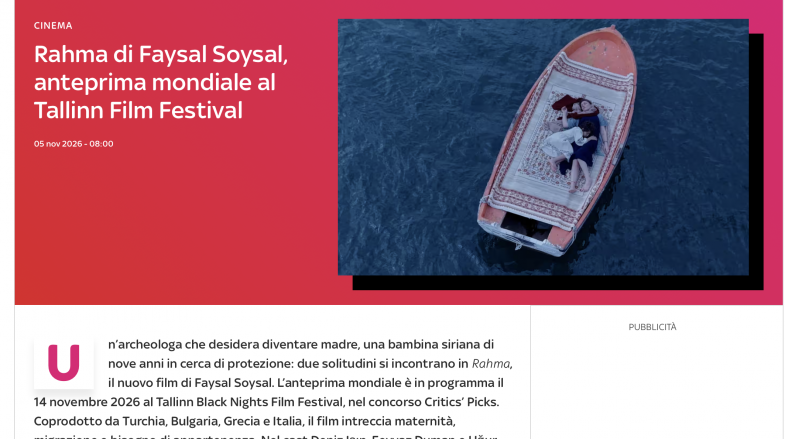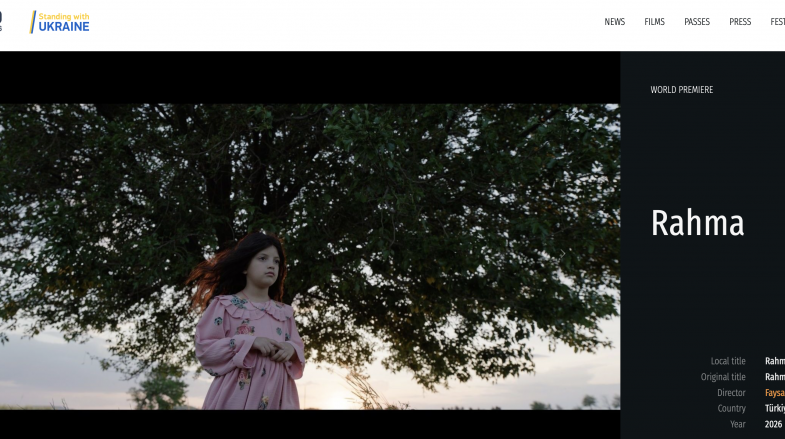


BLACK NIGHTS 2026 Critics’ Picks
Faysal Soysal • Director de Rahma
“Como poeta y director, no me gusta reflejar directamente las experiencias de la vida como si fueran vistas a través de un espejo”
por Veronica Orciari
– El director turco explica cómo su película transforma su experiencia y la de su esposa con la infertilidad en una historia de ficción sobre la maternidad, la paternidad y el desplazamiento
Este artículo está disponible en inglés.
Following the premiere of Rahma in the Black Nights Film Festival’s Critics’ Picks section, we caught up with Turkish director Faysal Soysal to discuss the film’s journey from script to screen and its personal implications, stemming from real life struggles with infertility.
Cineuropa: İbrahim and Meryem’s tormented journey to parenthood stems from your and your wife’s own experiences. Was it difficult to transform such an intimate chapter of your life into a fictional film?
Faysal Soysal: The journey of Meryem and İbrahim resonates with some of the emotions left over from what my wife and I went through. Of course, there are many aspects that don’t align exactly. In other words, we’ve never actually met a child like Rahma, and my wife wasn’t raised by a stepmother like Meryem, but she was always hesitant while we were looking into adoption. The film’s parallel narrative – which depicts people from different nations striving to find a home and hold on to life – is entirely fictional. As a poet and as a director, I don’t like to directly reflect life experiences as if through a mirror. My approach is akin to Kant’s aesthetic philosophy; in my work, I try to bring existing emotions to life by translating them into a different form.
The film takes its name from a young girl you encountered in Uganda. Why did you choose to draw inspiration from her for a different story setup?
Because homes in Gombe, Uganda, don’t have running water, young girls have been forced to haul it from an early age. Unfortunately, even when we were there, people’s homes still lacked running water. As a result, many of these girls suffer from inguinal hernias, but there are no surgeons in the region, and very few people are able to travel to Kampala to undergo surgery. Under the leadership of Dr. Orhan Alimoğlu from Doctors Worldwide, they performed about 70 surgeries while we were filming a documentary about their work there. One of those children was Rahma. Her energy, her gaze and her innocence deeply moved us. Once, when we were alone, I asked her what she saw in her dreams. She said she always dreams of being a bird, flying over different lands and crossing borders. I was deeply moved by this young girl’s passion for freedom in rural Gombe, so the film took its title from her, but the story itself emerged entirely as a narrative I reimagined for the Syrian border. Within the film, her name also creates subtextual associations with that of Mary, the mother of Jesus.
Rahma takes place near the Turkish-Syrian border. How important was the landscape in establishing the film’s atmosphere?
We specifically wanted to shoot the film in Urfa. There are other cities and towns in Turkey that border Syria, but Şanlıurfa is historically significant as the place where Prophet Abraham lived. More importantly, Göbeklitepe – the “zero point of history” – is located in Urfa. In Turkish, “Göbekli” literally means “bellied” and as visitors know, the temple is shaped like a pregnant woman’s abdomen. Ever since that time, people who couldn’t have children have come to this temple to tie strings, rags and the like to the wishing tree above it and make their wishes. My wife and I visited the site on our honeymoon and tied a piece of cloth to that tree to make a wish. Another unique feature of this place is that it is where one of the earliest known depictions of childbirth was discovered. There are other details as well, but ultimately, the sight of so many refugees – especially a group consisting mostly of children – struggling to cling to life as they fled the war is what created, in my mind, an ironic connection with the very reason for the site’s existence.
What were the biggest challenges you encountered?
One of the biggest challenges of the shoot was finding a child to play Rahma. I wanted the child to be a refugee, just as in the story. The child also had to be able to play both genders. Hair and makeup were another issue, but even though we weren’t entirely sure until the very end, I can say that it is our collaboration with Nagam Bireç that made this film possible. Had we failed in our work with her, the whole project would have fallen through and everyone would have gone home. Even one day before filming, we still weren’t sure –she had been intimidated by the crowd and hadn’t agreed to cut her hair as promised –, but thankfully we managed to get her used to it by treating it like a game, and she gradually grew to love it.
Another challenge was the language barrier. Our characters Meryem and Rahma were supposed to speak Arabic, while their uncle Nidal was meant to speak Arabic and Turkish, as well as a little English. Since Feyyaz Duman, who played Nidal, spoke Kurdish very well, we positioned him as a relative from a Syrian Kurdish background and adapted his extensive dialogue into Kurdish. Nevertheless, we sought professional support from an Arabic accent coach for both the Nidal and Meryem characters.
What are you working on next?
For quite some time now, I’ve been thinking about a cinematic world set in a magical-realist atmosphere, exploring death and the afterlife. At the same time, I’m interested in the following premise: “If we could know when we’re going to die, what would be the first thing we’d want to set right?” Aside from those ideas, I’m deeply saddened by what the children in Gaza are going through, and I occasionally think about a screenplay that would help us empathise with them. None of these ideas have taken concrete shape yet. Rahma’s journey through the festival circuit might also help shape my decision on which direction to pursue.